Understanding how lifecycle assessment applies to vessels — from design through decommissioning — and why it matters for compliance, procurement, and decarbonisation.

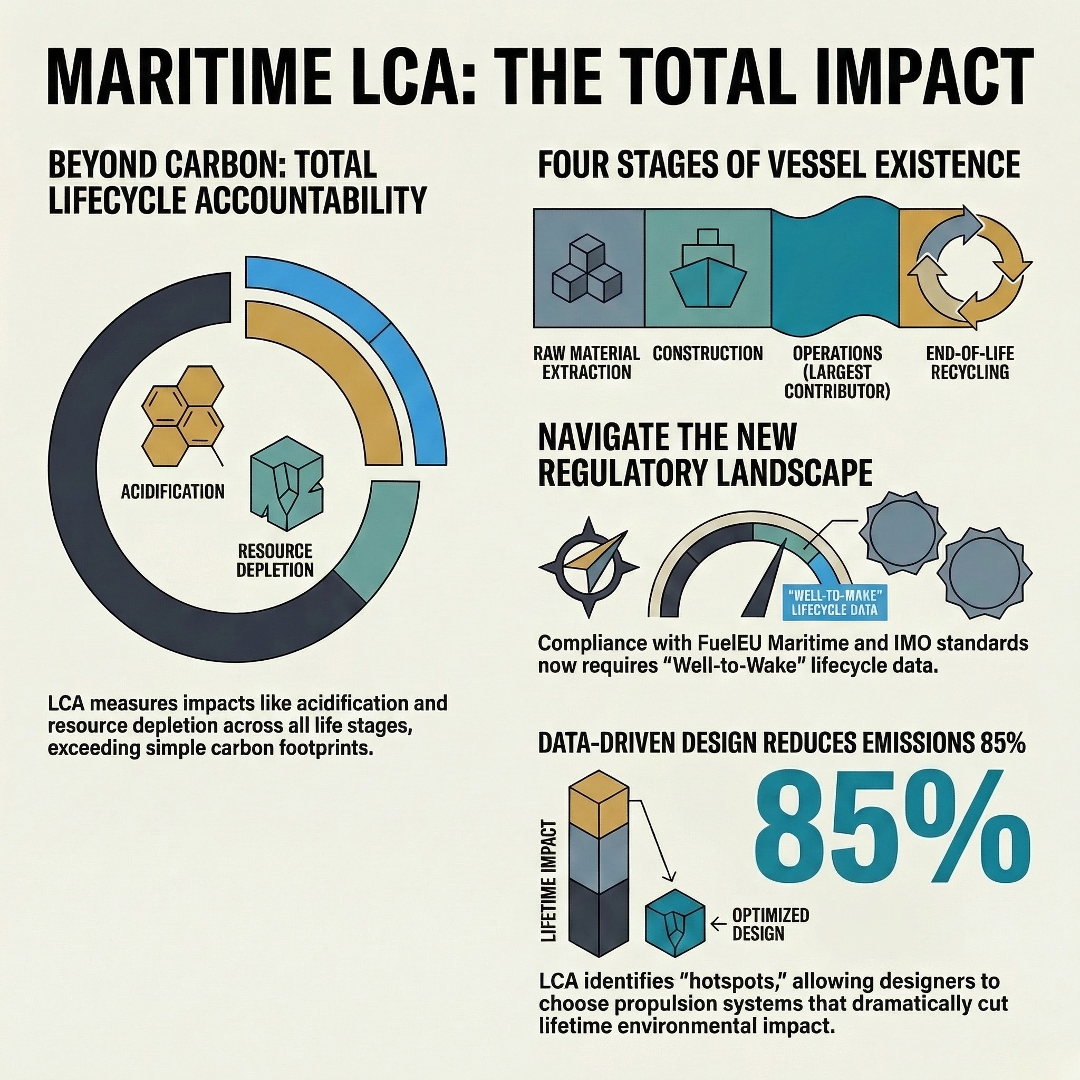
A maritime LCA (Life Cycle Assessment) provides a structured, standards-based method for quantifying the environmental impact of a ship across its entire lifespan. This guide explains what a ship LCA involves, how it differs from simpler carbon accounting methods, and where it creates practical value for shipowners, designers, and suppliers.
A maritime LCA — also referred to as a ship LCA or vessel LCA — is a systematic evaluation of the environmental impacts associated with a vessel throughout all stages of its life. It follows the internationally recognised ISO 14040 and ISO 14044 standards for lifecycle assessment.
The assessment covers four main lifecycle phases:
Raw material extraction and manufacturing. This includes the production of steel, aluminium, coatings, electronics, and propulsion components. The environmental burden of sourcing and processing these materials is quantified using emission factors from established databases.
Construction and assembly. Energy consumption during shipbuilding — welding, surface treatment, outfitting — contributes to the overall footprint. Different yards and construction methods produce measurably different results.
Operation and maintenance. This is typically the largest contributor to a vessel's lifecycle emissions, driven primarily by fuel consumption. It also includes maintenance activities, spare parts, lubricants, and dry-docking.
End of life. Decommissioning, dismantling, and recycling or disposal of materials. Responsible ship recycling can recover significant material value, but the process itself carries environmental costs.
A well-executed ship LCA connects these phases into a single, comparable dataset — making it possible to identify where the largest environmental impacts occur and where reductions are most effective.
The terms are sometimes used interchangeably, but they are not the same.
A carbon footprint typically measures greenhouse gas emissions (CO₂, CH₄, N₂O) expressed in CO₂-equivalents. It can cover a single phase — such as tank-to-wake operational emissions — or the full well-to-wake chain.
A lifecycle assessment is broader. It includes carbon emissions but can also evaluate other environmental impact categories such as acidification, eutrophication, resource depletion, and ecotoxicity. LCA follows a standardised methodology (ISO 14040/14044) with defined phases: goal and scope definition, inventory analysis, impact assessment, and interpretation.
In practice, many maritime stakeholders start with a carbon-focused LCA and expand the scope as regulatory and reporting requirements evolve.
Several regulatory developments are driving demand for lifecycle-based assessment in shipping.
FuelEU Maritime sets maximum limits on the greenhouse gas intensity of energy used by ships above 5,000 GT calling at EU ports. The targets are measured on a well-to-wake (WtW) basis, meaning they account for emissions across the full fuel lifecycle — from extraction and production (well-to-tank) through combustion onboard (tank-to-wake).
The baseline is 91.16 gCO₂e/MJ (the 2020 fleet average), with a mandatory 2% reduction from 2025, scaling to 80% by 2050. This well-to-wake approach is fundamentally a lifecycle methodology applied to marine fuels.
Since January 2024, the EU ETS covers CO₂ emissions from ships of 5,000 GT and above entering EU ports. The phase-in schedule requires surrender of allowances for 40% of reported emissions in 2025, 70% in 2026, and 100% from 2027. From 2026, CH₄ and N₂O emissions also fall within scope.
While the EU ETS is currently operational rather than lifecycle-based, it creates a direct financial incentive to understand and reduce emissions — making lifecycle thinking a natural next step for cost optimisation.
The IMO adopted its 2024 Guidelines on Life Cycle GHG Intensity of Marine Fuels at MEPC 81, establishing a framework for well-to-wake calculations and introducing a Fuel Lifecycle Label. At MEPC 83 (April 2025), new requirements on GHG fuel intensity were approved, taking effect from 2028, combined with a pricing and reward mechanism.
The direction is clear: the IMO is moving toward lifecycle-based regulation at the global level, not just within the EU.
The Corporate Sustainability Reporting Directive (CSRD) and the EU Taxonomy require companies — including shipping companies meeting size thresholds — to report on environmental performance using standardised metrics. Lifecycle data supports credible Scope 3 reporting and alignment with taxonomy criteria for sustainable economic activities.
Beyond regulatory compliance, a ship LCA has several practical applications.
During the design phase, LCA enables comparison of alternative materials, propulsion systems, and construction methods before commitments are made. For example, research has demonstrated that hydrogen propulsion can reduce lifecycle emissions by up to 85% compared to conventional marine gas oil, while electric propulsion achieves around 56% reduction. These figures only emerge through lifecycle analysis — operational data alone would miss the upstream impacts.
A ship LCA makes it possible to evaluate the carbon profiles of different suppliers and materials on a comparable basis. Green steel vs. conventional steel, different coating systems, alternative insulation materials — each choice has measurable lifecycle consequences. This supports procurement decisions grounded in data rather than marketing claims.
Charterers, cargo owners, and financiers increasingly request environmental performance data. A documented LCA provides credible, third-party-verifiable evidence of a vessel's environmental profile — a tangible advantage in competitive tender processes and green financing applications.
For shipowners and operators reporting under CSRD or to institutional investors, a vessel LCA provides the underlying data for Scope 3 (upstream and downstream) emissions disclosures. Activity-based LCA data is more accurate and defensible than spend-based estimates.
One of the most practical outcomes of an LCA is the identification of environmental hotspots — the specific lifecycle stages, components, or processes that contribute most to overall impact. This directs decarbonisation efforts where they will have the greatest effect, rather than spreading resources across low-impact areas.
A ship LCA follows the four-phase structure defined by ISO 14040:
1. Goal and scope definition. This establishes the purpose of the study, the system boundaries (cradle-to-gate, cradle-to-grave, or cradle-to-cradle), the functional unit (e.g., one vessel over a 25-year service life, or one tonne-kilometre of cargo transported), and the impact categories to be assessed.
2. Life cycle inventory (LCI). Data is collected on all relevant inputs (energy, materials, water) and outputs (emissions, waste, by-products) across the defined lifecycle stages. Data quality matters significantly here — activity-based data from actual operations produces more reliable results than industry averages or spend-based proxies.
3. Life cycle impact assessment (LCIA). Inventory data is translated into environmental impact scores using characterisation models. Common impact categories include global warming potential (GWP), acidification potential (AP), eutrophication potential (EP), and abiotic resource depletion.
4. Interpretation. Results are analysed to identify significant issues, evaluate data quality and sensitivity, and draw conclusions. This phase also generates actionable recommendations for design, procurement, or operational decisions.
Maritime LCA is technically demanding, and several challenges are worth noting.
Data availability. Collecting reliable data across a vessel's full supply chain — from raw material suppliers through construction yards to operational records — requires coordination across multiple organisations. Gaps are common, particularly for upstream manufacturing processes.
Functional unit definition. Choosing the right functional unit affects comparability. A per-vessel LCA is useful for design decisions, while a per-tonne-kilometre approach is more relevant for comparing transport modes or route efficiency.
Allocation in multi-output systems. Shipyards and suppliers often produce multiple products. Allocating shared energy and emissions to a specific vessel requires methodological choices that should be transparent and documented.
Temporal scope. A vessel may operate for 25–30 years. Assumptions about future fuel mixes, maintenance schedules, and regulatory changes introduce uncertainty that should be addressed through sensitivity analysis.
At ReFlow we provide digital lifecycle assessment for the maritime industry through ClimateDock — our vessel-focused LCA platform. Our approach is built on several principles:
Activity-based data, not estimates. We use actual operational and supply chain data rather than industry benchmarks or spend-based proxies. This produces results that are more accurate, more defensible, and more useful for decision-making.
ISO-compliant methodology. All assessments follow ISO 14040/14044 standards and are structured to support third-party verification, EPD creation, and regulatory reporting.
Circularity and end-of-life tracking. Our platform accounts for material recovery and recycling in the end-of-life phase, providing a more complete picture of a vessel's environmental performance.
Actionable outputs. Results are structured to support specific decisions — design trade-offs, supplier selection, compliance documentation, or investor reporting — not just to produce a number.
We work with shipowners, OEMs, and suppliers across Northern Europe, supporting over 300 companies in measuring and reducing their maritime environmental footprint.
The primary standards are ISO 14040 (principles and framework) and ISO 14044 (requirements and guidelines). For marine fuel lifecycle emissions specifically, the IMO's 2024 LCA Guidelines provide the framework for well-to-wake calculations.
This depends on the scope and data availability. A focused cradle-to-gate assessment with good data access can be completed in weeks. A full cradle-to-grave study covering a vessel's entire projected service life typically requires more time for data collection and validation.
Not directly in most jurisdictions — yet. However, FuelEU Maritime requires well-to-wake lifecycle calculations for fuel GHG intensity, the CSRD requires lifecycle-related environmental disclosures for qualifying companies, and the IMO's framework is moving toward lifecycle-based regulation from 2028. The trend is toward mandatory lifecycle reporting.
Well-to-wake (WtW) covers the lifecycle of the fuel — from production to combustion. A full vessel LCA covers the entire ship: materials, construction, operation (including fuel), maintenance, and end of life. WtW is a subset of a full vessel LCA.
Yes. An LCA conducted according to ISO 14040/14044, combined with relevant product category rules (PCRs), provides the data foundation for an EPD. Re-flow's platform is structured to support this workflow.