The market for lifecycle assessment software is growing, but most platforms are built for construction or consumer goods. Evaluating LCA tools for maritime requires a different set of criteria.

Lifecycle assessment software has matured considerably over the past decade. Platforms like Sphera (GaBi), SimaPro, One Click LCA, and Ecochain serve thousands of users across industries, and their capabilities are well documented. However, most of these tools were designed for specific sectors — construction, consumer goods, food, or general manufacturing — and their data libraries, workflows, and reporting templates reflect those origins.
Maritime has distinct requirements. A vessel is not a building or a consumer product. It is a complex, long-lived capital asset with a multi-decade operational profile, a global supply chain, and a regulatory environment shaped by the IMO, the EU, and classification societies rather than building codes or product safety directives. Evaluating LCA software for maritime use means assessing how well a platform handles these specificities.
This article walks through the key evaluation criteria without recommending a specific product. The goal is to help maritime professionals ask the right questions when assessing their options.
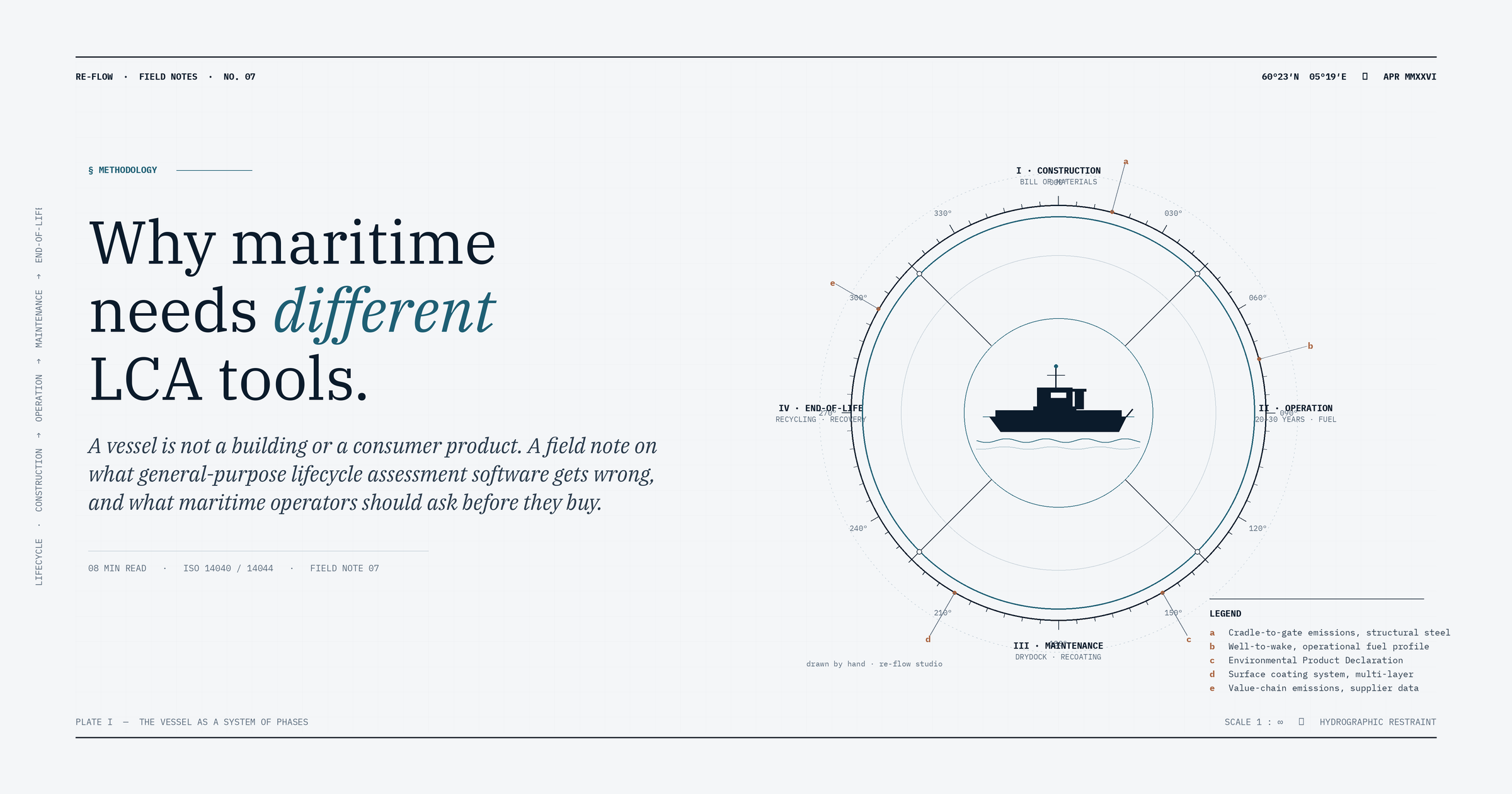
The most fundamental question is whether the software can model a complete vessel lifecycle. This requires handling the construction phase (bill of materials, shipyard energy, surface treatment), the operational phase (fuel consumption over 20-30 years, with different operational profiles), the maintenance phase (drydocking cycles, component replacement, recoating), and the end-of-life phase (ship recycling, material recovery credits).
General-purpose LCA tools can technically model all of these phases, but they require the user to build the model from scratch. There are no pre-configured vessel templates, no maritime-specific databases, and no built-in understanding of how a ship's lifecycle differs from a factory or a residential building.
Maritime-specific platforms, by contrast, may offer vessel templates, pre-loaded maritime material databases, and workflows designed around the typical data available to shipowners and yards. The trade-off is that these platforms may be less flexible for non-maritime applications.
The practical question is: how much modelling effort does the platform require to produce a credible vessel LCA? If the user needs three months of consultant time to set up a model in a general-purpose tool, the software cost is the least of the expenses.
LCA results are only as good as the underlying data. The lifecycle inventory databases embedded in or compatible with the software determine what materials, processes, and emission factors are available for modelling.
For maritime applications, the relevant materials include structural steel (various grades and production routes), marine-grade aluminium, copper alloys, specialised coatings (antifouling, anticorrosive, fire-retardant), marine fuels (HFO, MGO, LNG, methanol, ammonia, biofuels), lubricants and hydraulic fluids, electrical and electronic components, and insulation materials.
Major LCA databases like ecoinvent and GaBi cover most basic materials but may lack specificity for maritime applications. For example, the emission factor for "steel, low-alloyed" in ecoinvent represents a global average that may not reflect the actual production conditions at the mill supplying a particular shipyard. Similarly, marine coating systems involve multiple layers with different chemistries, and generic "paint" factors are poor proxies.
Some platforms allow users to create custom datasets or import supplier-specific data. This capability is important for maritime, where the gap between generic and specific data can be significant.
For shipowners subject to CSRD or pursuing Scope 3 measurement, the ability to collect and integrate supplier data is critical. This goes beyond traditional LCA modelling — it involves managing data flows from dozens or hundreds of suppliers, each providing information in different formats and at different levels of quality.
Key questions to evaluate include whether the platform supports supplier data collection workflows (questionnaires, templates, data import), whether it can handle multiple data quality levels (spend-based, average, supplier-specific) and flag the methodology used, whether it aggregates product-level data into company-level or vessel-level Scope 3 inventories, and whether it provides an API for integrating with procurement systems or external data sources.
Most traditional LCA tools are designed for product-level assessment, not supply chain data management. Platforms that bridge this gap — combining LCA methodology with operational data collection — are better suited to the Scope 3 reporting challenge that maritime companies face.
Maritime sustainability reporting operates within a specific regulatory framework. The software should support or at least be compatible with the key standards and regulations.
ISO 14040/14044 compliance is the baseline — any credible LCA tool should support these standards. Beyond that, maritime-specific considerations include alignment with the IMO's developing lifecycle GHG guidelines, support for FuelEU Maritime well-to-wake calculations, compatibility with CSRD and ESRS E1 disclosure requirements, the ability to produce Environmental Product Declarations (EPDs) following EN 15804 or relevant Product Category Rules, and alignment with EU Taxonomy technical screening criteria for maritime transport.
No single software platform currently covers all of these requirements out of the box. But the platform's architecture should be flexible enough to accommodate them as the regulatory landscape evolves.
There is an inherent tension between the depth of a full LCA tool and the accessibility needed for non-specialist users. Platforms like SimaPro and GaBi offer exceptional modelling depth but require significant LCA expertise to use effectively. Newer platforms like Ecochain and One Click LCA prioritise usability but may sacrifice flexibility for complex or non-standard applications.
For maritime companies, the relevant question is who will use the tool. If a dedicated LCA specialist or consultant will run the assessments, a deep, flexible tool is appropriate. If the tool needs to be used by procurement staff, sustainability managers, or engineers without formal LCA training, accessibility becomes a priority.
Some organisations opt for a hybrid approach: a specialist tool for detailed vessel LCA studies, and a more accessible platform for routine product carbon footprinting and supplier data collection. This avoids forcing one tool to serve two very different use cases.
Not every assessment requires a full, ISO-compliant LCA. Many maritime decisions — comparing coating systems, evaluating material alternatives, estimating a supplier's carbon footprint — can be adequately supported by a screening-level assessment that takes hours rather than months.
The software should support both levels. A screening LCA uses simplified inputs and generic data to provide a directional result. A full LCA uses specific data, detailed modelling, and sensitivity analysis to produce a result suitable for external reporting or third-party verification.
Platforms that only support full LCA impose unnecessary overhead on routine decisions. Platforms that only support screening lack the rigour needed for regulatory reporting or EPD development. The ability to scale between the two is a practical advantage.
The value of an LCA depends on how the results are communicated. For maritime, relevant output formats include vessel-level lifecycle emissions summaries (for newbuilding decisions and fleet comparisons), product carbon footprint reports (for supplier evaluation and procurement), Scope 3 inventories aligned with GHG Protocol categories (for CSRD reporting), EPD-formatted outputs (for manufacturers documenting their products), and data exports for integration with other reporting systems (ESG platforms, annual reports).
The software should produce outputs that are directly usable for the company's reporting obligations, without requiring extensive manual reformatting.
LCA software costs vary widely, from EUR 5,000–10,000 per year for entry-level platforms to EUR 50,000+ for enterprise tools with full database access. The total cost of ownership includes the software licence, database subscriptions (ecoinvent, GaBi, or proprietary databases), training and onboarding, and consultant support for initial setup and complex assessments.
Cloud-based (SaaS) platforms are increasingly common and offer lower upfront costs, automatic updates, and easier collaboration. On-premise installations are less common but may be preferred by organisations with strict data security requirements.
For maritime companies evaluating their first LCA tool, the total cost of the first year — including training, data setup, and at least one pilot assessment — is a more meaningful figure than the licence fee alone.
When assessing LCA software for maritime use, consider the following dimensions. Can the platform model a complete vessel lifecycle without extensive custom configuration? Does it include or support maritime-relevant material and process databases? Can it handle Scope 3 data collection from multiple suppliers at different data quality levels? Does it align with ISO 14040/14044 and relevant maritime regulations? Is the user interface accessible to the people who will actually use it? Can it produce outputs suitable for CSRD, EPD, and internal reporting needs? What is the realistic total cost of the first year, including training and data?
No platform will score perfectly on every dimension. The goal is to find the best fit for the organisation's specific needs, existing capabilities, and regulatory obligations.
The LCA software market offers plenty of capable tools, but maritime is an underserved sector. Most platforms require adaptation to handle vessel lifecycles, maritime supply chains, and sector-specific regulations. Companies entering this space should evaluate tools not just on their general LCA capabilities but on how well they serve the specific workflows and data challenges of the maritime industry. A trial project — such as a screening LCA of one vessel or a product carbon footprint for one component category — is often the most effective way to test a platform's fit before committing.