The EU's Digital Product Passport framework is coming for machinery, PPE, and spare parts. Here is the timeline, the data requirements, and how lifecycle assessments prepare you for compliance.

If you manufacture machinery, personal protective equipment, or spare parts for the construction or maritime sectors, the EU's Digital Product Passport will affect your products. Not eventually — within the next two to three years.
The Ecodesign for Sustainable Products Regulation (ESPR) establishes a requirement for structured, machine-readable product and environmental data to accompany virtually all physical products placed on the EU market. The revised Construction Products Regulation (CPR 2024/3110) adds sector-specific obligations. And from 2027, the new EU Machinery Regulation requires all machinery documentation to be digital by default.
For manufacturers of equipment that serves both construction and maritime applications — pumps, generators, safety gear, lifting equipment, engine components, wear parts — the question is not whether DPP applies, but when and what data you need to have ready.
This post explains the regulatory drivers, the timeline, what data is required, and how existing lifecycle assessment and emissions data gets you most of the way there.
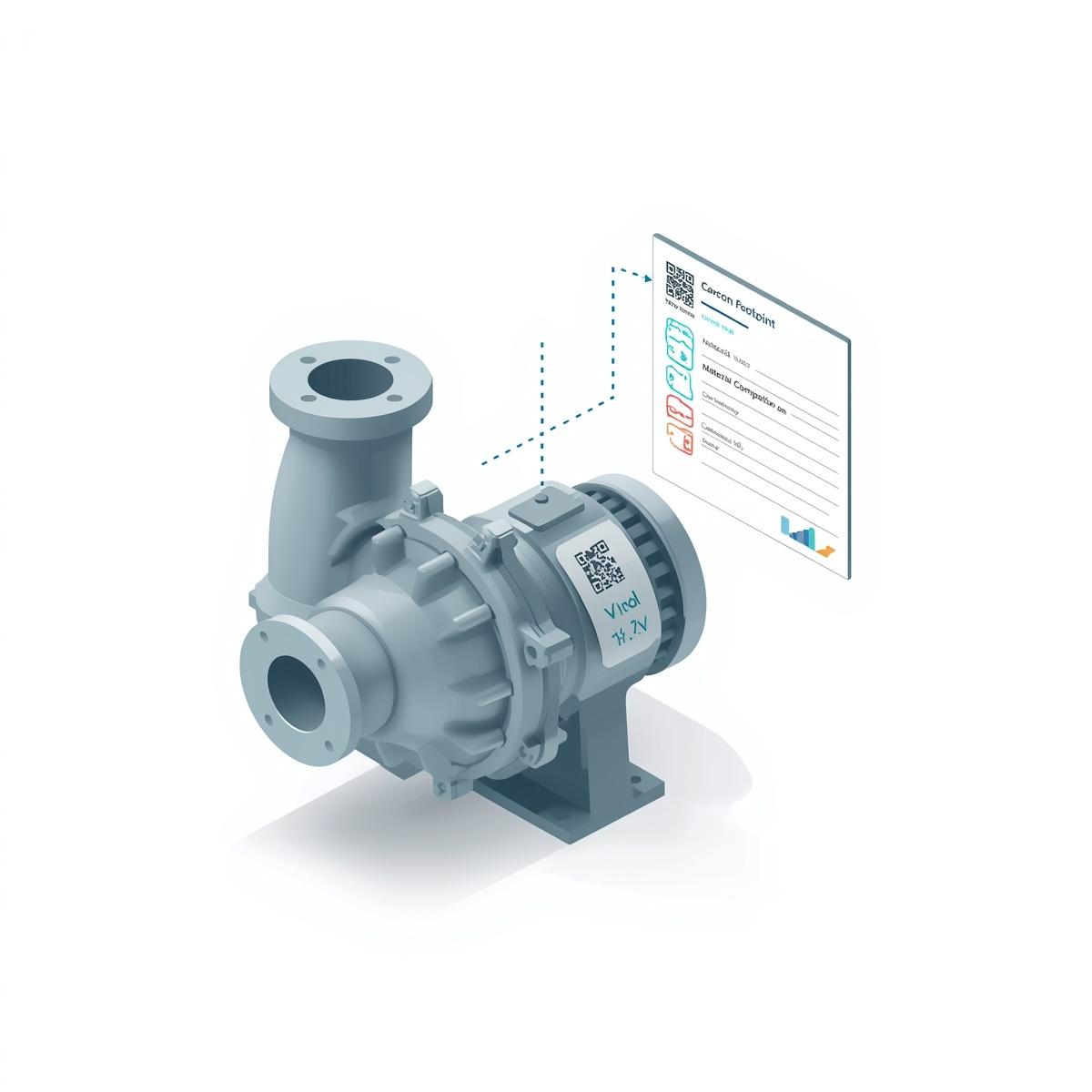
A Digital Product Passport (DPP) is a standardised digital record linked to a physical product through a unique identifier — a QR code, NFC tag, or RFID chip. It contains structured data about the product's composition, origin, environmental footprint, compliance status, and end-of-life properties.
The DPP is not a certificate or a label. It is a live, queryable dataset that follows the product through its lifecycle. Regulators can verify compliance, procurement teams can compare environmental performance, and end-of-life operators can assess recyclability — all from the same data source.
For equipment manufacturers, this means your products will need to carry digital records covering everything from material composition to carbon footprint data, accessible to anyone in the value chain with the right permissions.
Three pieces of EU legislation are relevant for equipment manufacturers operating across construction and maritime:
The Ecodesign for Sustainable Products Regulation (ESPR), adopted in July 2024, is the overarching framework. It covers nearly all physical products sold in the EU and empowers the European Commission to define product-specific DPP requirements through delegated acts. Industrial equipment and machinery are explicitly identified as priority product categories.
The revised Construction Products Regulation (CPR 2024/3110), generally applicable since January 2026, extends DPP requirements to construction products specifically. Its Chapter X establishes a dedicated "construction digital product passport system." The Commission's First CPR Working Plan for 2026–2029 identifies DPP as a central pillar, with first delegated acts expected mid-2026.
The EU Machinery Regulation (2023/1230), applicable from January 2027, requires all machinery documentation — manuals, declarations of conformity, risk assessments — to be available in digital format. While not a DPP regulation in itself, it mandates the same shift toward structured digital product data, and creates natural alignment with DPP requirements.
For manufacturers of dual-use equipment (construction and maritime), the practical implication is that multiple regulatory tracks converge on the same outcome: your product data needs to be digital, structured, and accessible.
The rollout is phased by product category. Here is what is known as of early 2026:
The important point for equipment manufacturers: even where your specific product category's DPP deadline has not been finalised, the data requirements are already clear. Manufacturers who start collecting and structuring the right data now avoid a compliance scramble later — and gain a competitive advantage in procurement processes that increasingly favour environmental transparency.
Based on the ESPR framework, the CPR Working Plan, and the Machinery Regulation, a Digital Product Passport for equipment products is expected to include:
For machinery and equipment manufacturers, much of this data already exists in some form — in technical documentation, compliance files, and supplier records. The gap is typically not the existence of data but its format and accessibility. Product carbon footprints, for instance, may have been calculated for a customer tender but sit in a PDF on someone's laptop rather than in a structured digital system.
This is the practical connection worth understanding. A lifecycle assessment (LCA) already quantifies most of the environmental impact data that a DPP will require: carbon footprint by lifecycle stage, resource depletion, energy use, and other impact categories defined by EN 15804 and ISO 14040/14044.
If your organisation already conducts LCAs, produces Environmental Product Declarations (EPDs), or calculates product carbon footprints for tenders or customer requests, you have the core environmental dataset. What the DPP adds is a standardised digital format, a unique product identifier, and a requirement for the data to be machine-readable and accessible via the EU registry.
The gap for most equipment manufacturers is data management:
Rather than treating DPP as a future compliance exercise, equipment manufacturers can take concrete steps now that also strengthen existing operations.
1. Map your data landscape. Identify what product and environmental data you already have — LCA results, EPDs, carbon footprints, supplier declarations, compliance documentation — where it lives, and in what format.
2. Digitise your environmental data. If your lifecycle data is locked in consultant reports, tender documents, or spreadsheets, prioritise moving it into a structured digital platform. This is the single most impactful preparation step.
3. Align compliance and sustainability data. DPP brings together data that often sits in separate silos — technical compliance (CE marking, DoC) in one system, environmental data (LCA, carbon footprint) in another, and material composition data in a third. Start planning how these connect.
4. Engage your supply chain. DPP requirements demand upstream transparency. Begin collecting supplier-level emissions data, material origin information, and substance declarations — especially for high-impact components and materials sourced internationally.
5. Pilot with one product line. Select a product with existing LCA or EPD coverage and build a prototype DPP dataset. This reveals gaps in data availability, system integration, and internal workflows before deadlines arrive.
ClimateHub, developed by Re-flow, manages the environmental and lifecycle data that forms the core of every Digital Product Passport. For equipment manufacturers operating across construction and maritime, it provides the data infrastructure needed for DPP readiness.
What the platform covers:
ClimateHub bridges the gap between the lifecycle and emissions work you may already be doing and the structured digital datasets that the DPP registry will require.
The most practical first step is understanding how your current data maps to DPP requirements. We offer a free DPP readiness assessment where we review your existing lifecycle, emissions, and product data — and identify what is already covered, what gaps remain, and how to close them efficiently.
Whether you are building on an existing EPD programme or starting your environmental data journey, ClimateHub provides a clear path from current state to DPP compliance — for machinery, PPE, spare parts, and any other equipment you place on the EU market.
This post was last updated in March 2026. Regulatory timelines are based on publicly available EU documentation and are subject to change as delegated acts are finalised. We will update this page as new requirements are confirmed.